


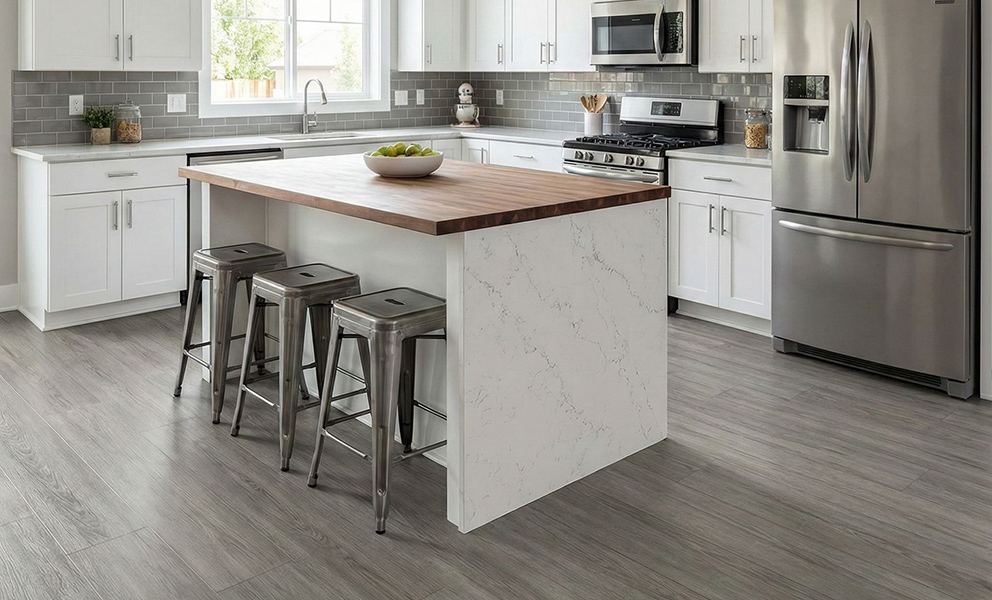
Discover why modern vinyl flooring is an unexpected but genuinely eco-friendly kitchen flooring option. Learn how leading brands support sustainability through innovative material science, minimal embodied carbon, and lifecycle management, all while using UK terminology.
Jump To Section
- The Lifecycle Approach: Redefining “Eco-Friendly” with Modern Vinyl Flooring
- Minimal Embodied Carbon of Modern Vinyl Flooring
- Phthalate-Free Formulations in Modern Vinyl Flooring
- Resilience and Thermal Efficiency of Modern Vinyl Flooring
- Ten Eco-Focused Questions & Answers for the Kitchen Renovation
- Conclusion: No Need for Compromise
The Lifecycle Approach: Redefining “Eco-Friendly” with Modern Vinyl Flooring
The UK’s shift towards sustainable living has profoundly impacted the building and renovation sector. For the kitchen—the most resource-intensive room—choosing flooring goes beyond aesthetics; it requires a deep dive into the product’s entire lifecycle.
While traditional “green” materials often focus solely on the source (e.g., fast-growing bamboo or reclaimed wood), sustainability standards for modern vinyl flooring demand a broader view. This “cradle-to-grave-to-cradle” perspective evaluates:
- Sourcing & Manufacturing: Energy use, material inputs, and emissions.
- Use Phase: Durability, maintenance, and impact on indoor air quality.
- End-of-Life: Recyclability and waste reduction.
Modern vinyl flooring (LVT), such as advanced Pro-Tek systems, excels in this comprehensive model, presenting a compelling case against materials with high embodied carbon or limited longevity.
Minimal Embodied Carbon of Modern Vinyl Flooring
The embodied carbon of a material—the total greenhouse gas emissions associated with its production and transport—is a critical sustainability metric where this technology performs surprisingly well.
- Manufacturing Efficiency: Unlike fired materials (like ceramic or porcelain tiles) or high-density natural stone, the production of quality advanced resilient flooring often requires significantly less high-temperature processing. This reduced energy demand translates directly to a lower carbon footprint during the manufacturing stage.
- Reduced Transportation Weight: Vinyl is considerably lighter than natural stone, concrete, or even many engineered woods. Lighter products require less fuel for transport from the factory to the UK supplier, and then to the consumer’s home, further decreasing the overall logistics-related carbon emissions.
Phthalate-Free Formulations in Modern Vinyl Flooring
While many people associate plastic with chemicals, the evolution of the material is a crucial, non-duplicate point.
- Non-Hazardous Plasticisers: Historically, a major environmental and health concern with vinyl was the use of certain phthalate-based plasticisers. Leading brands of contemporary vinyl solutions have proactively shifted to phthalate-free plasticisers, often plant-based or DOTP (Dioctyl Terephthalate), which are proven to be non-hazardous.
- Chemical Stability: Once installed, modern vinyl flooring becomes chemically inert. Unlike materials that can harbour mould or require aggressive sealing (which may use high-VOC products), the stability of a high-spec LVT surface prevents microbial growth and maintains its structure without continuous chemical intervention.
Resilience and Thermal Efficiency of Modern Vinyl Flooring
Two often-overlooked environmental benefits arise from the structure of modern vinyl flooring:
- Superior Water Resistance (Moisture Ingress Prevention): In the damp environment of a UK kitchen, water damage can swiftly necessitate premature floor replacement. High-quality LVT/SPC (Stone Plastic Composite) construction is virtually impervious to moisture ingress, preventing the costly and wasteful replacement cycles associated with water-damaged laminate or certain wood floors.
- Insulation & Underfloor Heating (UFH) Compatibility: While not a significant insulator on its own, the low thermal resistance of modern vinyl flooring makes it exceptionally compatible with underfloor heating systems. It allows heat to pass through efficiently and distribute evenly. This efficiency means the UFH system requires less energy to maintain a comfortable temperature, providing long-term energy savings for the homeowner—a significant contribution to reducing domestic energy consumption.
Ten Eco-Focused Questions & Answers for the Kitchen Renovation
Here are 10 specific Q&As on eco and environmental topics related to modern vinyl flooring:
Q1: What does “Embodied Carbon” mean for my kitchen flooring choice?A: It’s the total emissions resulting from manufacturing, transporting, and installing your floor. Choosing lighter, less-fired materials like modern vinyl flooring can significantly reduce this upfront carbon cost.
Q2: How can I ensure the vinyl I choose is genuinely low-impact?A: Look for third-party accreditations, such as FloorScore or A+ ratings from independent European indoor air quality schemes, ensuring minimal release of harmful gases (VOCs).
Q3: Is “Recyclable” the same as “Recycled Content”?A: No. Recycled Content means the product contains material diverted from waste. Recyclable means the product can be reprocessed at its end of life, often through specialist take-back schemes.
Q4: How does the durability of modern vinyl flooring contribute to a “circular economy”?A: By lasting 20+ years, vinyl flooring maximises the lifespan of resources, delaying the need for new material extraction and reducing construction and demolition (C&D) waste—a key principle of the circular economy.
Q5: I’m installing underfloor heating (UFH). Does my flooring choice affect my heating bill?A: Yes. Materials with high thermal resistance (e.g., thick timber) force the UFH to work harder. The low thermal resistance of modern vinyl flooring maximises heat transfer efficiency, lowering the energy needed to heat the room.
Q6: Why are phthalate-free plasticisers important from a health perspective?A: They remove chemicals (phthalates) that can off-gas over time and are linked to health concerns, ensuring better Indoor Air Quality (IAQ), especially important in high-use areas like the kitchen.
Q7: Do I need to buy special eco-friendly cleaners for modern vinyl flooring?A: No, that’s the benefit! Due to the floor’s robust, non-porous finish, simple warm water and a mild, PH-neutral detergent are usually sufficient, eliminating the need for harsh, chemical-heavy cleaning products.
Q8: How does the click-fit installation system save resources compared to glue-down?A: Click-fit minimises the use of chemical adhesives (which can off-gas VOCs), and also reduces the number of unusable off-cuts, leading to less waste taken to the local tip.
Q9: What is “bio-based” or “plant-based” vinyl, and is it better?A: This refers to vinyl where the plasticisers or a portion of the raw materials are derived from renewable sources (like vegetable oil) rather than 100% fossil fuels, lowering the reliance on finite resources.
Q10: When considering a replacement, is it better to choose LVT or a stone tile?A: While stone is natural, its high embodied carbon (from quarrying, processing, and heavy transport) and the need for cement/grout often give it a higher overall environmental footprint than a durable, light, and recyclable modern vinyl flooring system.
Conclusion: No Need for Compromise
The pursuit of an eco-friendly kitchen should focus on the holistic environmental footprint. Modern vinyl flooring, particularly high-specification LVT like Pro-Tek, provides a solution that is durable enough to prevent frequent replacement, manufactured with lower embodied carbon than many traditional options, and promotes healthier indoor air quality through low-VOC, phthalate-free composition. For UK homeowners, choosing modern vinyl flooring is a pragmatic step towards a genuinely sustainable kitchen.